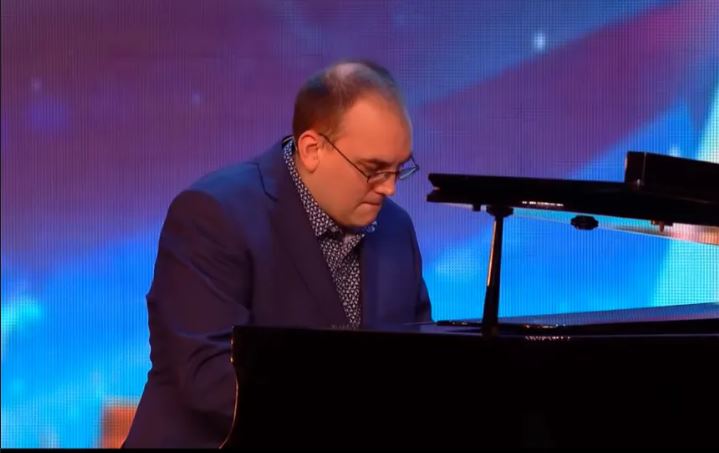
It happened gradually, and then all at once.
That is the only accurate way to describe how a single performer at a piano became, within the space of a few minutes, something that filled an entire room with orchestral sound.
The transformation had a texture to it.
First the violin — tentative and directional, arriving from somewhere in the seated crowd.
Then a second instrument from a different part of the room — the moment when tentative became clearly deliberate.
Then the understanding, spreading visibly through the audience from row to row, that this was not a technical accident.
This was the plan all along.
What followed was the audition equivalent of a room waking up completely.
People who had been sitting back leaned forward.
People who had been only half-watching gave their full attention.
The low background murmur that lives in any live audience quieted into something focused and collective.
By the time the conductor appeared — stepping forward from the crowd with the relaxed authority of someone who had been waiting patiently for exactly this moment — the room had already transformed its energy entirely.
The voices from the balconies were the final layer.
Harmonies descending from above, meeting the orchestral sound rising from the floor, wrapping around the piano at the center of all of it.
What had started as one note in a quiet room had expanded into something immersive — the kind of sound that registers in the chest before the brain finishes processing what the ears are hearing.
Britain’s Got Talent has produced a significant number of memorable auditions across its history.
Very few of them have managed to turn the room itself into an instrument.
This one did.
