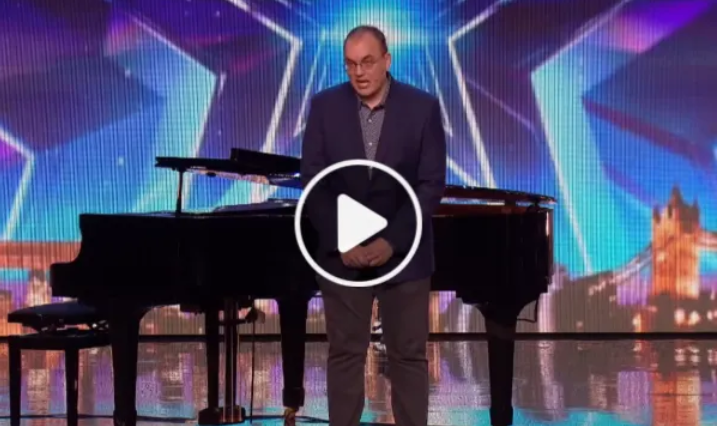
Before the performance began, a significant portion of the people in that room already knew something the rest of the audience did not.
They had arrived carrying instruments.
They had found their seats.
They had sat down like ordinary audience members — settling in, looking around, giving every outward indication that they were simply there to watch.
And then they waited.
This is the element of a flash mob performance that almost never gets discussed — the patience it requires from every participant before the moment finally arrives.
For every musician sitting in that crowd, watching Nicholas Bryant walk onto the stage, the entire early portion of the audition was a performance in itself.
Looking like they were simply watching.
Containing any reaction that might reveal what they were actually about to do.
Holding the secret completely intact until the precise moment they were needed.
For the rest of the audience — the people with no knowledge of what was coming — those opening moments were exactly what they appeared to be.
A single performer.
A piano.
A familiar melody.
The violin that emerged from the crowd was the first crack in that surface.
One unexpected note, and the room’s entire understanding of itself began to quietly rearrange.
Because the people who had been hiding suddenly were not hiding anymore.
And the audience that had believed it was watching a solo performance suddenly understood that it had been, from the very beginning, part of the performance itself.
That specific reversal — the realization that you were already inside something without knowing it — is one of the most powerful things a live performance can produce.
This one produced it in front of millions of people.
