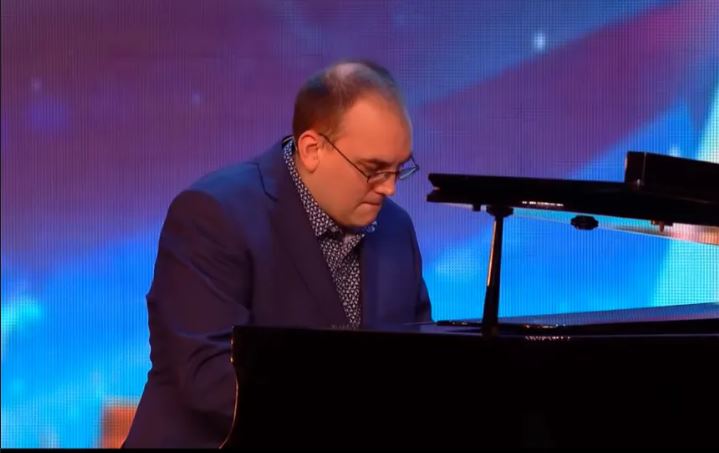
Nicholas Bryant did not walk onto that stage with the energy of someone trying to win a room before the performance started.
He walked on with the energy of someone who already knew exactly what was about to happen — and had chosen, deliberately, to let the room discover it on its own terms.
That is a specific and uncommon kind of confidence.
Not the loud, performative kind that announces itself in an introduction designed to lower defenses before the music begins.
The quieter, more patient kind that comes from knowing precisely what you have prepared and being willing to wait for the right moment to let it land.
The judges saw a man and a piano.
The audience saw the same thing.
What neither of them saw was everything that had already been arranged around them — sitting in ordinary seats, indistinguishable from the crowd, waiting for its cue.
The first notes were genuinely beautiful — a Queen melody played with a level of control that speaks to real musical ability, not just the calculated use of a familiar song.
But they were also, in a very specific sense, a distraction.
Because while the audience was settling into its assessment of the piano performance in front of them, the actual performance had already quietly begun.
It was in the seats.
It was in the aisles.
It was in the balconies.
When the first hidden musician stood and revealed themselves, the reaction in the room was immediate.
And when the second followed, and the third, the nature of the evening shifted entirely from what anyone had walked in expecting.
Nicholas Bryant had sat down at a piano as one performer.
By the time the final note resolved, he had turned the entire room into something it had not arrived knowing it was going to become.
