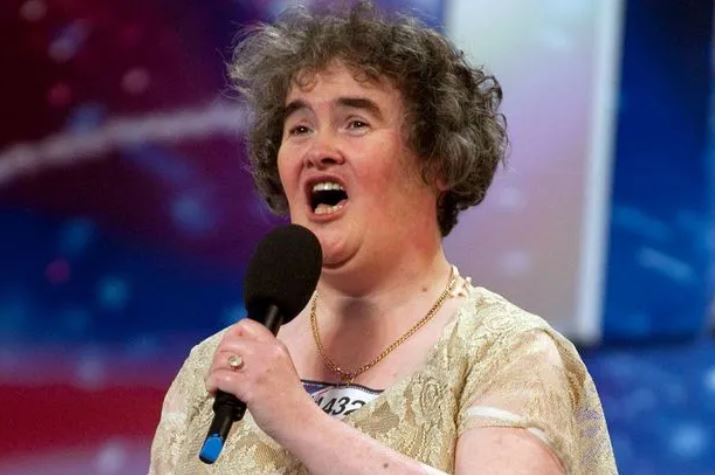
Before the audition, before the standing ovation, before the record-breaking album sales and the global headlines, Susan Boyle was simply a woman from Blackburn, West Lothian.
A small village in Scotland where she was born, raised, and had spent most of her 47 years living a life that the wider world had never paid any particular attention to.
She had grown up with a love of singing that stretched all the way back to childhood.
She sang in her local church, in community events, in small performances that never extended much further than the people who already knew her name.
For years, she had also been the primary caregiver for her mother — quietly setting her own ambitions to one side to fulfill that responsibility.
When her mother passed away in 2007, Susan found herself facing a question she had been gently postponing for most of her adult life.
What did she actually want?
The answer, when it came, was the same one it had always been.
She wanted to sing.
Not for a small audience in a village hall.
For the world.
She applied for Britain’s Got Talent with that intention fully formed, aware that the cameras, the crowd, and the global viewership would see everything — and that there would be nowhere to hide if it went wrong.
She prepared with the same voice she had always had — unsharpened by years of industry feedback, unfiltered by formal training, completely and honestly her own.
On the night she walked onto that stage, the crowd’s initial reaction was immediate and largely dismissive.
There was laughter — not cruel, but the casual, comfortable laughter of an audience that has already decided what category a person belongs in.
She acknowledged it with a smile and a theatrical little shimmy that seemed to lean into the expectation rather than resist it.
And then she sang.
And the category she had been placed in dissolved completely.
What the audience witnessed that night was not a performance shaped and polished by the machinery of the entertainment industry.
It was something rarer and more powerful than that.
It was a human being, finally given a stage large enough to match the voice they had been quietly carrying for decades.
The standing ovation was real.
The tears in the audience were real.
The disbelief on the judges’ faces was real.
And the woman at the center of all of it — the one who had spent her life being overlooked — was finally, undeniably, and unforgettably seen.
