It happened fast.
The shift from skepticism to silence took only a matter of seconds — but it was so total, so dramatic, and so complete that everyone who experienced it, either in person or on screen, felt it like something physical.
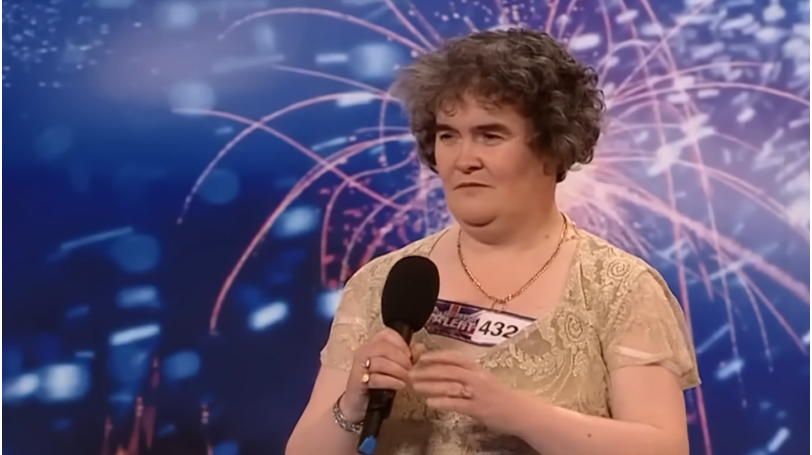
When Susan Boyle first appeared on the stage of Britain’s Got Talent, the crowd’s reaction formed almost immediately.
Not hostile — but dismissive in that particular, casual way that forms when a room full of people collectively decides that what they are about to witness is going to be mildly amusing rather than genuinely impressive.
There was laughter.
There were raised eyebrows.
There was the low murmur of an audience settling into comfortable expectation, certain they already know how this is going to go.
Susan saw all of it.
She acknowledged the energy in the room with a smile and a theatrical little shimmy that seemed to play into the audience’s mood rather than push against it.
And then she sang.
The silence that followed the first note was not the silence of disinterest or confusion.
It was the silence of a room that has been stopped mid-breath — the kind that forms when something unexpected happens and the brain needs a moment to catch up with what the ears are reporting.
People who had been laughing stopped.
People who had been murmuring to their neighbors turned back toward the stage.
The atmosphere that had been light and slightly mocking shifted into something it hadn’t been a minute earlier.
It became reverence.
Hundreds of strangers, who had arrived at a television talent show with no particular expectations for this particular moment, were now held together in a single shared experience.
They were listening.
Really, fully, completely listening.
And what they were hearing was a voice that had been quietly carrying something extraordinary inside it for decades, finally given the space to let it out.
By the final note, there were tears in the audience.
There were tears on the faces of the judges.
The woman who had walked out to laughter left the stage to a standing ovation that lasted long after the music had stopped.
It remains one of the most striking reversals in the history of live performance.
And it happened in just a few minutes, on an ordinary Saturday night, in a room full of people who had almost missed it entirely.
